Israel Defies Warning By Hezbollah Chief Nasrallah To Rocket Tel Aviv, If Israeli Jets Again Raid Hezbollah Targets In Beirut Defense Minister Amir Peretz Orders IDF To Prepare For Advance To Litani River
After warning civilians to evacuate the areas, Israeli jets again hit Hezbollah targets in Beirut. The air-strikes came just hours after Hezbollah leader Sheik Nasrallah warned he would rocket Tel Aviv if Beirut was targeted.
Israel will not negotiate with Hezbollah leader Sheik Hassan Nasrallah – that’s the message of the renewed Israeli air-strikes on Beirut. Thursday, another day of intense rocketing from Lebanon, eight Israeli civilians were killed. Four more Israeli soldiers fell in southern Lebanon as the IDF moved to drive the Katyushas out of range.
The night before, Sheik Nasrallah warned if Israel jets again raided Beirut, he would launch missiles at Tel Aviv, Israel’s largest city. At the same time, Nasrallah offered to halt his rocket bombardment, if the IDF called off its offensive against his guerrillas. Israel’s Justice Minister Haim Ramon rejected Nasrallah’s offer saying:’ Don’t believe a word of this arch-terrorist’s lies; Nasrallah wants to preserve his rocket capability to attack Israel in the future’. Ramon was speaking a day after eight Israeli civilians were killed and dozens more injured when Hezbollah fired more than one hundred rockets into Israeli towns and villages. Four more IDF soldiers were killed as the IDF carved out a Hezbollah-free buffer zone of some kilometers along the Israeli-Lebanese border. Ramon said the call-up of three reserve divisions was enough to advance north to the Litani River but the security cabinet would have to decide first. After consulting with Prime Minister Ehud Olmert, Defense Minister Amir Peretz ordered the IDF to prepare for such an operation.
In an interview with Israel Radio, Ramon said the IDF has made many achievements. In his view: ‘No one in the Middle East will again attack Israel without realizing the consequences’. He noted that some months ago, an IDF simulation exercise found it would take 4 to 6 weeks to eliminate the Hezbollah rocket threat. And he noted four weeks would not be up until next Wednesday. Ramon, a confidant of Olmert, believed that Israel has changed the rules of the game. The war has altered the situation not only in southern Lebanon but in Lebanon as a whole. He hoped that Lebanon would become a sovereign state from where rockets were not launched at civilians in a neighboring country.
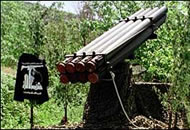
THE WAR – Why is it proving to be so difficult for the IDF to stem the rocketing attacks from Lebanon? The short range Katyushas have a range of some 20 kilometers and are very easy to launch, they can be transported even on the back of a donkey. The guerrillas can drive to a launch site in a pick-up truck and then set up and fire off their rockets within one to two minutes. They can then speed off in their vehicle. Often, timers are used to launch the Katyushas after the guerrillas are long gone. Most of Hezbollah’s 13,000 rockets were of this type so there are still thousands around. It is very difficult for Israeli aircraft to target the Katyushas but the ground troops now combing southern Lebanon may be more effective. But IDF ground forces will have to move to the Litani River to put them out of range.
The IAF’s high- tech has been more successful in taking out Hezbollah’s longer range Fajr and Syrian missiles that require more time for set-up and launch. Nearly all of the Hezbollah launchers that fired rockets at Afula and Beit-Shean have been destroyed.
Will Nasrallah now risk losing these missile launchers by ordering them to target Tel Aviv? On this score, an unnamed IDF officer has been quoted as saying: ‘ If rockets fall on Tel Aviv, Beirut will burn’. Cabinet Minister Ramon reacted by saying IDF officers or politicians should not make such statements.
On the ground, the guerrillas are fighting from inside fortified bunkers. One Israeli expert compares it to the Japanese positions on Iwo Jima and other islands in the Pacific during World War II. U.S. marines suffered high casualties before they started using flame throwers. However, Israel has no intention of using such tactics that have been banned by international law. In addition, Hezbollah has also built positions inside towns and villages and the hilly terrain also favors the defenders. Another feature of the fighting has been the guerrillas extensive use of anti-tank rockets that have taken many IDF casualties. They are devastating when fired at infantry. Moreover, the Israeli Merkava-Chariot tank may be the best protected in the world, but it is designed for frontal tank battle at long distances not for close combat fighting. In addition, the various IDF infantry and paratroop regiments have been engaged with the Palestinian intifada over the past six years which is different from the guerrilla warfare in Lebanon. A senior IDF officer says 90% of their activity has been tracking down lightly armed terrorists. Moreover, the reserve divisions now called up, have not trained due to budget cutbacks. They needed some days to upgrade their capability and have now joined the battle.
But Israel may face a bind over the multi-national force. Prime Minister Olmert says although the IDF will not remain in southern Lebanon, it will stay put until the force is in place. Otherwise, Hezbollah would simply move back down to their former positions. For the multi- national force and the Lebanese army to have any chance to enforce law and order, Hezbollah must be cleaned out of southern Lebanon. This is why Olmert insists there must be a multi-national force in place before a cease-fire. But what if the Lebanese government or Hezbollah refuse to accept the multi-national force? What does Israel do then? To pull out without a deal would mean Hezbollah’s return; to remain would mean becoming an occupier again. This was what transpired after 1982 when Israel drove out the PLO but then got bogged down in Lebanon. Some experts say the only solution may be to exert pressure on the Lebanese government.
By the way, Iranian President Ahmadinejad has his own ‘final solution’. He proposes ‘a cease-fire first and then wiping out Israel later’.