
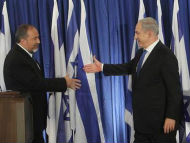

Hamas Leader Khaled Meshal's Latest Threat To 'Liberate All Of Palestine' Serves To Strengthen Netanyahu-Lieberman Against 'Peace' Camp In Israeli Election Campaign Likud- Beteinu Leaders Binyamin Netanyahu & Avigdor Lieberman Escalate Rhetoric To Boost Their Strong Image In Face Of Threats Facing Israel
What is the most dominant factor that determines the winner of an Israeli
election campaign? Without fail it is how Israeli voters perceive Palestinian
intentions and without fail the Palestinian leadership takes a hostile stance
smack in the middle of the campaign. Analyst David Essing is of the view it
is happening once again.
Take a look at what’s been going. Is there any sign the Palestinians are
sincerely interested in forging a compromise with Israel, be they Palestinian
President Mahmoud Abbas in the West Bank or Hamas in Gaza. First there’s
Hamas leader Khaled Mashal who arrived in Gaza declaring: “All of
Palestine is ours, from the Mediterranean Sea to the Jordan River: from
Kiryat Shemonah in the north to Eilat in the south- we shall liberate it all!”
There could be no mistaking the roar of approval from the tens of thousands
of cheering Palestinians not only in Gaza but also among the
more ‘moderate’ Palestinians in several West Bank towns. The throng in
Gaza was ecstatic when Mashal declared the recent rocketing of Israel,
notably Tel Aviv and Jerusalem, was only a taste of what the Israelis could
expect in the future.
This latest rabble-rousing recalls the Arab battle-cry
that called for ‘throwing the Jews into the sea’ when the UN General
Assembly voted in favor of the Palestine Partition plan in 1947. What has
changed more than ten wars and six decades later in the Palestinian
consensus when Hamas represents more Palestinians than does
Abbas? Back in 1947, the official Arab position was couched in more
diplomatic terms: “The Arab states cannot tolerate the break in their unity
and this menace to their political and economic life….. Thus, they oppose
the creation of the Jewish state in Palestine, now or at any time in the
future.’ At the time, the neighboring Arab states rallied behind the
Palestinian rejection of the first two-state solution. While there has been a
shift in the Arab world, highlighted by the peace accords that Egypt and
Jordan signed with Israel, Hamas has not budged an inch. Khaled Mashal
reaffirmed the Palestinian aim, not only of all Gaza and the refugee camps
abroad but also of a sizeable number of Palestinians in the West Bank. This
is the stark reality. On the other hand, Palestinian President Mahmoud
Abbas, who controls the West Bank after being routed from Gaza, has
eschewed terrorism but has steadfastly refused to negotiate a two-state
compromise with the current government of Israel. Instead of accepting a
generous offer from Israel’s former Prime Minister Ehud Olmert in 2008,
Abbas launched a diplomatic war against Israel in the U.N. General
Assembly that has recognized ‘Palestine’ as a non-member observer state.
The whole idea of the Oslo Agreement, to which the Palestinians are a
signatory, is that Palestine would be the outcome of a comprehensive peace
agreement with Israel which would also guarantee the Jewish state’s
security. So what impact are these two Palestinian developments likely to
have on Israeli voters when they cast their ballots on January 22nd? It is hard
for most Israelis to see a Palestinian partner out there ready to negotiate
peace with Israel.
On the other hand, Right-wing politicians such as Prime Minister Binyamin
Netanyahu and former Foreign Minister Avigdor Lieberman have been
playing to the Right wing gallery after the controversial announcement to
build 3,000 new housing units on the West Bank between the town of Maale
Adumin and East Jerusalem. Bear this in mind, Israeli politicians like their
colleagues elsewhere, tend to do whatever is necessary to get reelected.
Netanyahu is banking on his tough stance winning him voters who will
perceive him as a strong leader who can take on the international
community, Iran, the Palestinians, whatever. So far the polls show that
Netanyahu will likely be the next prime minister although he is looking over
his shoulder at two new challenges.
The charismatic Naftali Bennet is
spearheading ‘Jewish Home’, an ultra-right party Jewish Home which
opposes the two-state solution. Bennet has succeeded in siphoning off Likud
voters who are annoyed at the Likud’s amalgamation with Lieberman. On
the Left, Labor’s feisty Shelly Yachimovich is making a determined effort to
corral low income Sefaradi voters who traditionally vote Likud. As a rule,
they support a tough stance on the Palestinian question. In effect,
Yachimovich is sending them the message: ‘The hell with Palestinian peace
plans, it should be the economy and Netanyahu is a piggish capitalist who
backs the rich against the poor’. Look for Tzipi Livni to attack, what is a
specter for some Israelis, the possibility that Avigdor Lieberman could
become Israel’s next defense minister.
The recent accord, gives Lieberman
the power to choose any cabinet portfolio he wishes, if Likud-Beiteinu
forms the next cabinet. Lieberman has hinted that he might decide to carry on as foreign minister but who knows? And what of Lieberman’s resignation
in light of Attorney General Yehuda Weinstein’s decision to prosecute him
on a breach of trust charge after dropping the more serious fraud case.
Lieberman is confident that there will be a swift trial, possibly with a plea
bargain, ending with a verdict that will enable him to continue his political
career after a legal rap on the knuckles.