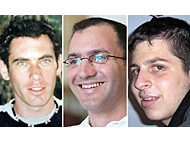

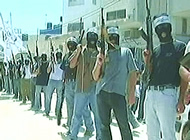

Israel At Odds Over Exchanging Abducted IDF Soldier For Palestinian Killers Dov Yinon: 'Palestinian Terrorists Should Be Released On Condition They Will Be Tracked Down And Executed Or Deported If They Revert To Violence'
Prime Minister Ehud Olmert and his top advisors have been consulting on the list of hundreds of security prisoners that the Palestinians are demanding in return for the release of IDF Corporal Gilad Shalit. The Israeli cabinet is expected to take a final decision on whether to free Palestinians with Israeli blood on their hands. IsraCast analyzes the various views on this painful issue that has been dominating the Israeli media.
The redemption of prisoners has always been one of the most hallowed values in Israeli society. Today the state is agonizing over how many Palestinian terrorists should be freed in return for the abducted IDF soldier Corporal Gilad Shalit. The Palestinian list runs into the hundreds including some with ‘ blood on their hands’ – terrorists involved in the murder and maiming of Israeli civilians and soldiers. Should Israel now agree to set them free knowing that past experience proves that some will return to suicide bombings and other acts of violence? But what of the suffering of Corporal Shalit and his family? He did his duty serving as a combat soldiers with his unit protecting the Israeli border when Palestinian gunmen crossed over killed three other soldiers and abducted Shalit who was lightly wounded. The pros and cons cut to the core of the public debate in the Israeli media at this time.
On the most basic human level the question is posed – ‘Ask yourself if it was your own son, would you want the Israeli government to release terrorist killers in order to get him back?’ To this obvious Yes there is a resounding No from some parents of relatives brutally murdered by a terrorist. In one case, a bereaved mother of a child said yes – she sympathized with Gilad Shalit’s mother and her joy on the return of her son. The bereaved father thinks differently. He said: ‘When my daughter was murdered, I thought of trying to take the law into my own hands and trying to kill her killer myself. But I consoled myself with the thought that the state would punish the terrorist with a long prison term. I cannot bear the idea that he will now be set free’.
See CNN report on Israeli civilians – many of them were murdered by terrorists the Palestinians want released in exchange for Gilad Shalit.
The killers and those who sent them were caught after Israeli security personnel worked long, hard and dangerously to bring them to justice. After all that will they simply be freed to again threaten more innocent Israelis? This would be a major incentive to other Palestinians to join the terrorists knowing that even if they do get caught they can also expect to be released when another Israeli is kidnapped. It will obviously be a big boost to abducting more Israelis in the future. Those opposed to releasing terrorists with blood on their hands also argue that soldiers know they face the risk of being killed on duty and must also be ready to face captivity. The counter- argument contends that the terrorists try to kill and kidnap anyway and they don’t really need any ‘encouragement’. Moreover, it is crucial for the morale of Israeli soldiers to know that if they are captured, everything will be done to secure their release. If the state sends soldiers on dangerous missions, it is duty – bound to retrieve them from captivity in the same manner it would risk the lives of other soldiers on rescue missions if the prisoner’s location was known.
The most prominent terrorist reportedly on the Palestinian list is a political leader Marwan Barghuti who is serving five life sentences for involvement in the killing of five Israelis. He gave the orders for the terror attacks. Barghuti of the Fatah organization, headed by President Mahmoud Abbas, enjoys wide popularity on the West Bank. Barghuti worked hand in glove with former Palestinian Chairman Yasser Arafat. At one time, Barghuti was considered a moderate and a potential leader who might be able to lead the Palestinians to peace with Israel. Labor Knesset Member Ami Ayalon, a former Shabak security chief, says an Israeli decision on Barghuti should depend on a Shabak assessment about whether Barghuti will return to terrorism. Ayalon told Israel Radio that when he was Shabak director he could issue such an appraisal of every Palestinian prisoner.
An IsraCast suggestion: the late Dov Yinon, a senior IDF intelligence officer and Arab affairs commentator recommended an unequivocal condition for the release of any Palestinian terrorists who are released as part of a prisoner exchange. Yinon said it should be made clear that if they revert to terrorism, the Israeli security forces will hunt them down and either expel them from the Palestinian territories or execute them. A reliable Israeli legal source supports this approach. The source explained that if the terrorists have been brought to justice in a court of law but are released before serving out their sentences, then Israel would have legal grounds for taking drastic measures. When IsraCast presented this approach to a senior Israeli security official he replied that some of the terrorists are potential suicide bombers anyway who would not be deterred by the threat of a targeted killing. However, Palestinians like Barghuti who either give the orders or help send the suicide bomber on his or her way are a different story. They send others. A reporter once asked the wife of Rantisi, a prominent Hamas leader, whether she would also send one of her sons as a suicide bomber. Her irate reply was: ‘What, are you crazy!’