
Israeli Prime Minister May Soon Have To Face Tough Choices On Palestinians, Iran & Gilad Shalit Speculation Rampant About Movement On Renewal Of Palestinian Peace Talks & Shalit Prisoner Exchange Isracast: Israel Declares It Will Not Be The First To Introduce Nuclear Weapons Into the Middle East – Will It Also Act To Bar Any Other State From Becoming First To Introduce Nuclear Weapons?
Over the past
summer months Palestinian peace talks remained in the diplomatic
doldrums, secret contacts on a Shalit prisoner exchange dragged on
while the current internal unrest in Iran cast another shadow over the
proposed nuclear negotiations with Tehran. However, the IsraCast update
is that these slumbering but vital issues may soon reawaken on the
international stage.
Far back, IsraCast quoted an anonymous
Israeli source, who pointed out that the newly elected Prime Minister
could fall back on the idea of a ‘moratorium’ on settlement building
that was adopted by non-other that the ultimate hardliner Menachem
Begin during peace talks with Egypt’s President Anwar Sadat in 1977.
What may be in the cards now, is that Israel will freeze building at
settlement on the West Bank for six months, but not in East Jerusalem.
The Likud leader draws a red line when it comes to Israel’s capital
city; even if Netanyahu agreed to, which he doesn’t, the current
coalition government would likely fall. Although there has been no
official confirmation of the deal, the angry Egyptian response
indicates this indeed may be coalescing behind the scenes. Egypt’s
Foreign Abu Reit has rejected such an understanding that would
acquiesce in Israel’s continued construction in East Jerusalem, which
he claims, belongs to all Arabs. It should be recalled that during the
Camp David summit of 2000, Egyptian President Hosni Mubarak sent a
stern message to Palestinian leader Yasser Arafat warning that he had
no mandate to compromise on Jerusalem with Ehud Barak and Bill Clinton.
One explanation may be that the Egyptians, who have a border with both
Gaza and Israel, have been left out of the picture. Back home, the
conjecture that Netanyahu may have conceded to Obama’s demand to halt
building at West Bank settlements, has raised the eyebrows of some of
his Likud MKs as well as his farther to the right coalition partners.
(Labor’s Ehud Barak would obviously be delighted with the renewal of
Palestinian negotiations. It will not only placate Obama but also those
critical Labor Mks who are needling Barak to bolt the government.
At the same time, Netanyahu again found that although European leaders
such as Gordon Brown, Nicole Sarkozi, Angela Merkel and Dmitry Medvedev
support, unequivocally, Israel’s right to exist they also insist, just
as firmly, on the eventual establishment of Palestine. Therefore, the
Europeans demand that Israel must continue along the diplomatic course
with the Palestinians no matter how times the Palestinians torpedo it.
After the Palestinians elected radical Hamas to office in the last
Palestinian election, only half of the Palestinian camp is, at best, in
favor of peace talks with Israel. The other half, Hamas ruled Gaza,
backs Iran’s goal of wiping Israel off the map. Even so, it is
abundantly clear that even under these condition the U.S. and the E.U.
will not allow Israel to sit back and do nothing. This was the case
after the repeated Palestinian rejections of peace and their unswerving
constancy to terrorism , be it Oslo(1993), Camp David (2000), the Road
Map (2003) or Ehud Olmert’s most recent efforts. On this the Europeans
are fully coordinated with Obama. (In fact, even Barak’s predecessor
George Bush also insisted that Israel persevere with the Road Map
proposal although the Palestinians continued the terrorism and Gaza
even voted Hamas into office).
This is the political reality that
induced Likud leader Binyamin Netanyahu to finally utter his support
for the two-state solution, even if he may believe a Palestinian state
will prove to be an anathema for Israel – a strategic threat to her
existence. On his European tour, Netanyahu spoke of his winning formula
‘a demilitarized Palestinian state that recognizes the Jewish state’.
This was turned down flat by the recent Palestinian conference that
convened in Bethlehem: a Palestinian state yes, but a ‘Jewish’ state
never! The Palestinian view is there is no Jewish people just the
religion of Judaism and a religion does not deserve a state. Be that as
it may, the Israeli Prime Minister appears eager to pay the price for a
renewal of peace talks, apparently believing that diplomatic lull will
invite others to push their private positions. Obama is reportedly
drafting his own peace plan, which has always been the wont of nearly
every U.S. President. In other words, if an Israeli prime minister does not show some movement on his own, others will get him moving in their direction. (And
everyone of course knows how to win over the hearts and minds of Hamas
religious fanatics, who are no less radical than al- Qaeda or the
Taliban).
There is a flip side to this diplomatic coin now being forged – the
U.S. would push harder for stiffer sanctions against Iran. After
Tehran’s brutal crackdown on young Iranians protesting the recent
rigged election, the Obama administration appears to have dispelled any
illusion that diplomatic jaw-jaw would persuade the Iranians to halt
their nuclear weapons project.
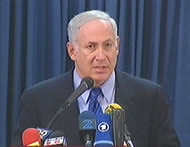
In Russia, Netanyahu with President Medvedev at his side, Netanyahu
repeated the long-held Israeli position that: ‘Israel will not be the
first to introduce nuclear weapons into the Middle East’. Russia, which
is Iran’s major nuclear supplier, is officially opposed to an Iranian
nuclear bomb but in the same breadth claims there is no evidence that
Tehran is developing nuclear weapons. Moscow has also consistently
opposed the imposing of stiffer sanctions on Iran with which Russia has
made billions of rubles from its nuclear sales to the Iranians. (Could
it be the current Russian regime wouldn’t mind an Israeli military
strike knocking out Iran’s nuclear installations in order to resell its
hi-tech to the Iranians?).
The Russians of course defend their devious
deals by contending that the nuclear know-how they sold the Iranians
was for peaceful purposes only. I once asked Prof Yuval Ne’eman, the
late Israeli physicist, if there was any scientific truth to this
argument. Ne’eman replied: ‘Does anyone really think there is a
separate set of nuclear physics for peaceful and military purposes!’ So
much for the Kremlin’s cynicism. The Russians are not alone. Even
today’s Germany, without doubt a sincere friend of the Jewish state, is
one of Iran’s leading trade partners, although it threatens to wipe
Israel off the map. The Israeli ambassador once said that Chancellor
Angela Merkel is not happy with this state of affairs, but she responds
by saying that the big German industrialists told her that if they
didn’t sell to the Iranians, Germany would lose out because her
European competitors would jump in to sell Iran anyway.
This summer, the Germans have again moved in as middle-men between
Israel and Hamas in the prisoner exchange contacts for the release of
IDF soldier Gilad Shalit who was abducted in a cross border raid into
Israel more than four years ago. Since then, the Palestinians have
violated every international convention by refusing the International
Red Cross even one visit to see him. Several Israeli media headlines
say the Germans have issued an ultimatum giving Hamas until September
1st to accept a reported exchange of some 450 terrorists for Shalit.
However, at Sunday’s cabinet meeting, Prime Minister Netanyahu played
down the speculation that the soldier’s release may be imminent.
Hamas
has been trying to squeeze as many of the most dastardly terrorists as
possible out of the exchange. Terrorists directly responsible for the
blowing up of crowded buses and restaurants that murdered over one
thousand Israeli civilians and maimed thousands more. But it is not
just a painful emotional issue, mainly for the bereaved families; the
directors of the two secret services, the Mossad and Shabak, are both
opposed to setting loose arch-terrorists. And with good reason based on
past experience. In 1985, Israel freed over eleven-hundred Palestinian
terrorists in exchange for three IDF soldiers who were captured during
the First Lebanon War. Those released terrorists later formed the hard
core for the First Intifada that claimed many of the aforementioned
casualties. This is the real and present security threat involved.
Again, former Prime Minister Ehud Olmert, considerd to be a ‘softy’
compared to Netanyahu, tried hard but could not bring himself to
release some of the terrorists demanded by Hamas.
Be that as it may,
the public pressure on the government is immense and unceasing to
‘Bring Home Gilad’ and celebrities are about to launch a TV campaign to
this end. This is just one of the tough decisions Netanyahu, whose
eldest son has just been drafted into the IDF for non-combat duty, will
have to make as the summer draws to a close. The Prime Minister, who
himself served in the elite Sayaret Matkal Special Forces unit, is
obviously well aware of all the issues at stake including that of the
State’s obligation to bring back its best and bravest fighters, if at
all possible.
Then of course there was the odious article in the Swedish newspaper Aftonbladet to
wit: Israeli soldiers not only stole but also sold Palestinian body
parts. It could only call to mind the anti-Semitic Nazi newspaper ‘der
Sturmer’ that spread such similar slander against the Jews from 1923
until the end of World War II. Naturally, outrage swept throughout the
Jewish state not only over the spurious article but no less so over the
reaction of the Swedish government, whose predecessor chose to remain
neutral during the Second World War. (Although it did give refuge to
the Jewish refugees who fled from Nazi- occupied Denmark and Poland).
Here in Israel, the Swedish ambassador naturally expressed her
government’s dissociation from the article. But lo and behold! Back in
Stockholm, diplomats in the Swedish Foreign Ministry rapped her
knuckles with the reprimand that because Sweden enjoys complete freedom
of the press, Swedish officials were not to get involved. Again, Sweden
had chosen to remain neutral. But the outrageous article does raise an
insidious aspect of Israel bashing that is sometimes apparent, under
closer scrutiny, in the international media.